
manufacturing management software
Manufacturing management software for production stages and materials
Manufacturing management software on Odoo can organise bills of materials, production orders and work stages alongside inventory. We configure the workflow and any quality checks included in the agreed scope.
Manufacturing management software: what the service covers
The order reaches sales in a message, then gets retyped for the production supervisor. Nobody knows which stage a customer’s order stopped at. The store issues material with no document, so actual cost drifts from the estimate. When a shipment is late, the manager asks five people to find who knows why.
A production system gives each order a number, stages, an owner and a cost, and shows its status to everyone as it changes.
Odoo's manufacturing apps, step by step
Bills of materials: the recipe for each product
Manufacturing builds a bill of materials per product listing materials, quantities and allowed scrap. Multi-level bills work: a finished product made of semi-finished parts that have their own bills. Kits and substitutes for materials are supported when an item runs out.
Manufacturing orders: from demand to finished goods
A manufacturing order comes from a sales order or a reorder rule. The system calculates the materials needed and reserves them from stock. If something is short, it proposes a purchase request directly. The supervisor sees orders on a board, a list or a calendar.
Work centres and stages
You define work centres: a printing machine, a cutting section, an assembly line. Each has its capacity, working hours and hourly cost. An order turns into work orders that pass through the stages in sequence, and operators log the start and end of each stage on a tablet on the factory floor.
Quality
Check points can sit at any stage: a measurement, a photo or a pass and fail note. A failed item goes to rework or scrap with the reason recorded. Quality and scheduled machine maintenance modules belong to the Enterprise edition.
Actual cost
Order cost is built from materials consumed, work-centre hours and scrap. Compare it with the estimate and you see which product earns more than another, and you price the next quote on a real figure.
Subcontracting
If you send materials to an outside workshop for one stage, the system tracks quantities sent and received and the subcontractor’s cost.
How production connects to the rest of the system
A sales order in Sales triggers the manufacturing order. Inventory issues materials and receives finished goods. Purchase orders what is short. Accounting records production cost and stock value. See inventory and purchasing and accounting software for those apps, and Odoo implementation for the whole setup.
When your factory is different: a system built on your stages
Factories differ. A garment maker has design, sample and print stages, a furniture workshop has specifications per order, a food plant has batches and shelf life. We handle what we can with Odoo settings and program the rest as a custom module: an order specification form, sample approvals, exit documents or a daily supervisor report. See Odoo module development.
A real project: the GTP factory system
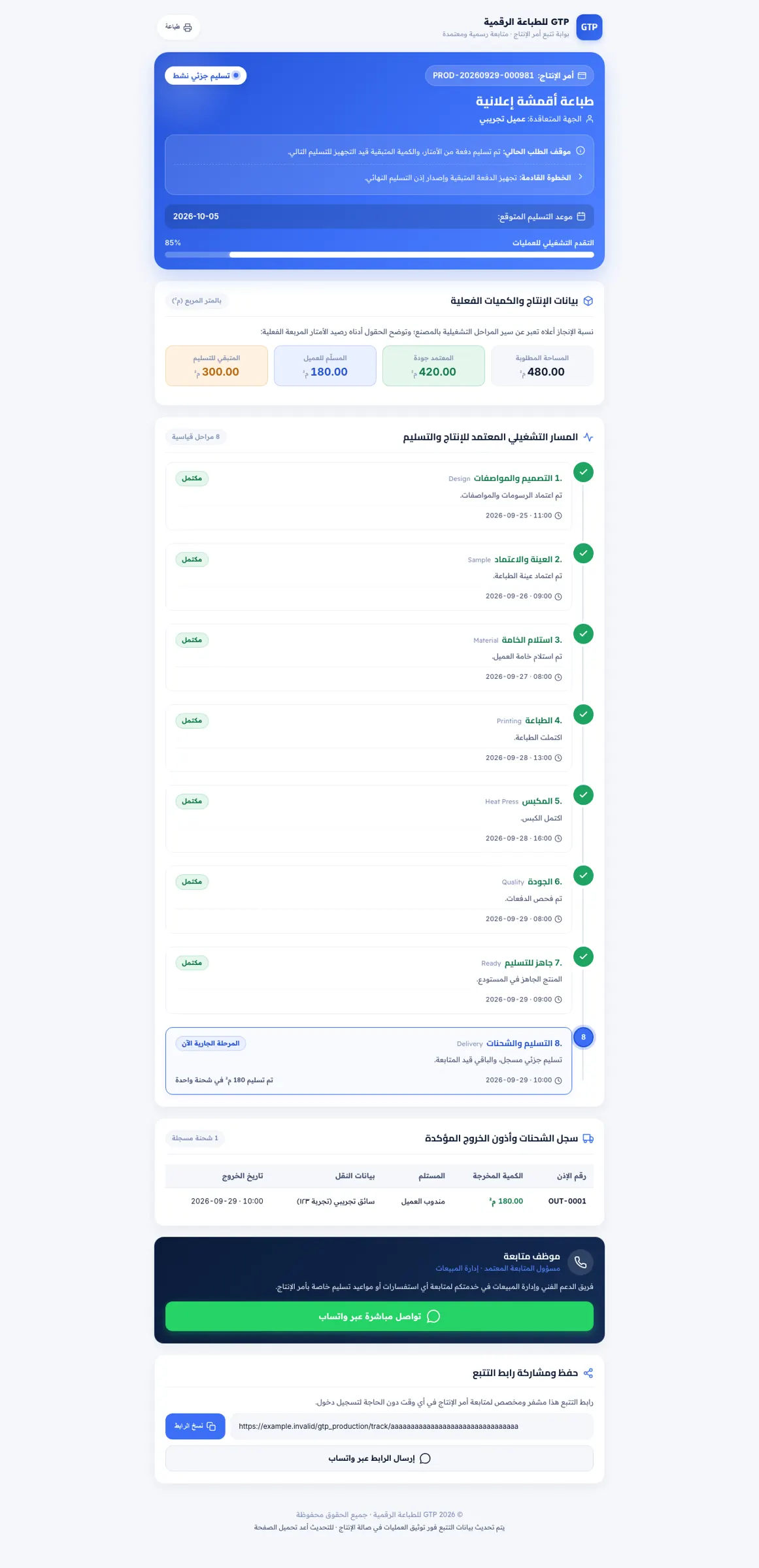
For GTP Ghuniem Textile Printing, a sublimation printing factory, we delivered a system that follows each order across nine stages: quote, design, sample, material, warehouse, printing, quality, collection and delivery. It has approvals and permissions, entry and exit documents with scannable QR codes, a mobile app and an AI assistant called Haidi. It runs on Perfex CRM with a production module, not on Odoo, but the idea is the same: the whole production flow in one system. Read the details: GTP factory system.
Typical rollout order
- Understand the flow. A call or visit where we draw production steps as they happen, not as the paperwork says.
- Items and bills of materials. Raw materials, semi-finished and finished goods with codes.
- Work centres and stages. Machines, sections and capacities.
- A trial manufacturing order from start to finish on one product.
- Quality and cost. Check points, cost calculation, and a comparison with your own figures.
- Floor tablets. Set up the operator screens.
- Roll-out. Remaining products and sections once the first product is steady.
Moving data and training the team
We import materials, products and bills of materials from Excel after cleaning them, and stock balances from a physical count. The data migration and training page explains how.
Training runs by role: the supervisor who plans orders, the operator who logs stages on a screen, the storekeeper who issues and receives, and the accountant who reviews cost. Each role gets its own videos.
After launch
You receive a handover file with settings and permissions, and we follow the first weeks to adjust bills of materials and capacities where reality differs from the estimate. Later you can add a mobile app for operators or a dashboard for senior management. See mobile apps.
Packages and the written quote
We review what you need, then send a written quote that sets the scope, timeline and deliverables. The written quote fixes the scope and the timeline, and we start after you approve it.
Frequently asked questions
It suits both. A small workshop starts with bills of materials, manufacturing orders and stock, and adds stages and quality when it needs them.
Yes, with a tablet or phone where the operator logs a stage's start and end. The site needs a network connection, either internet or a local network.
It adds materials consumed, work-centre hours and scrap. The result is only as accurate as the stage logging, so we train operators to record it.
Sometimes, depending on whether the device can export its data. Send device models with your inquiry and we check feasibility before fixing the scope.
We compare the two with you. Odoo gives manufacturing, stock and accounting ready to adapt to your flow, while a custom system suits a process no setting can match. Our article Odoo or custom software explains the criteria.

Put your factory stages on one screen
Send your products and how they are made, and we reply with a written quote that sets the scope and timeline.